
ECG-MR’s clearance shows the value and boundaries of a PCCP
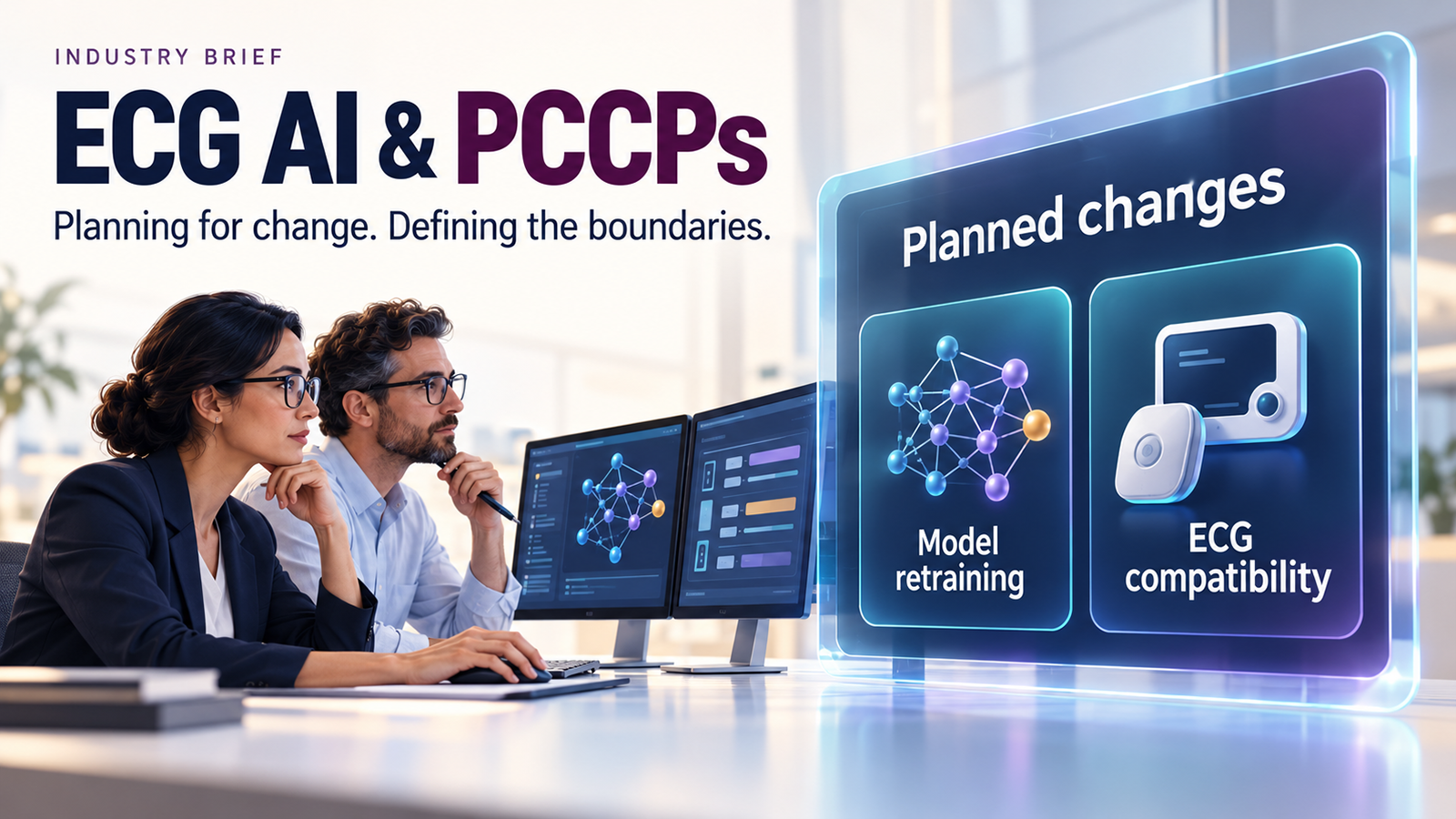
An ECG software company may already know what it wants to improve after launch: refine its model and accept recordings from more acquisition systems. Those ambitions affect the commercial roadmap long before the team knows how it will validate each update.
FDA’s September 25, 2026 clearance of Tempus ECG-MR, Tempus AI, Inc. offers a concrete example of planning for that work. The clearance includes a predetermined change control plan, or PCCP. The useful development question is what the company has prepared to demonstrate when it makes a future change—not simply whether its submission contains a plan. [1]
What the authorization covers
Tempus ECG-MR analyzes resting, non-ambulatory 12-lead ECGs for signs associated with moderate or severe mitral regurgitation in a specified at-risk population aged 65 and older. It is not a standalone diagnostic tool or a system for serial patient monitoring. This is a distinct use from ambulatory rhythm analysis. [1]
Tempus’s public 510(k) summary describes two change categories in PLN-000503: retraining using original and new data, and adding support for ECG machine models. It also describes validation controls, including separate validation data and acceptance criteria. [1]
The letter establishes that FDA cleared the PCCP; the sponsor’s summary describes its approach. The public material does not provide the full plan or enough detail to transplant its validation design into another product’s submission.
The flexibility depends on the boundary
The summary excludes continuous learning in the field and says updated models will be trained, tuned and locked before release. That is this product’s approach. FDA’s August 2025 final guidance also considers automatically implemented modifications, with recommendations addressing their boundaries and evaluation. ECG-MR therefore should not be read as a universal rule that every PCCP must use locked releases. [1,2]
FDA’s letter states that changes consistent with the established PCCP do not require a new premarket notification. [1] The guidance explains how planned modifications and their evaluation belong together; it recommends changes that are specific and can be verified and validated. These are FDA recommendations, rather than a new general permission to modify an AI device however its developer chooses. [2]
For development planning, the consequence is straightforward. A commercial statement such as “more compatible machines are coming” leaves important work undefined. The team still needs to decide which additions are useful, how their effects will be evaluated, and what would prevent an update from being released.
Budget for the capability to evaluate the change
Zaliance’s practical reading is that a PCCP strategy should influence the evidence program before the company commits to its future product roadmap.
Consider a hypothetical team adding another ECG acquisition system. Demonstrating that a file reaches the analysis engine answers an integration question. It does not, by itself, answer whether the analysis remains suitable for that input source. The team needs a reasoned basis for the performance evaluation it proposes, including what existing evidence can support and what the new source requires it to examine.
That reasoning can change the commercial sequence. A compatibility addition may be attractive, yet impractical for the next release if the team cannot obtain suitable evaluation data. A narrower initial expansion may be more credible than a broad promise backed only by an interface specification. These are planning judgments, not facts about Tempus’s confidential validation program.
Model improvement raises a related resource question. Access to more training data does not automatically establish access to the independent evidence needed to judge the resulting update. The budget needs to support making the change and deciding whether the changed product is acceptable. Treating the second task as a final testing step can leave a roadmap dependent on evidence that nobody has arranged to obtain.
This clearance is useful because it connects a future-facing product strategy to an authorized, bounded change plan. For another manufacturer, the next decision is which anticipated changes can be described and evaluated convincingly enough to justify including them in its own PCCP strategy. The value comes from preparing to execute that plan, not from borrowing the label.
References
[1] FDA. Tempus ECG-MR, K254297. Clearance letter dated September 25, 2026, PDF pp. 1–2; indications for use, PDF p. 4; sponsor 510(k) summary, PCCP section, printed p. 6 of 7 (PDF p. 10).
https://www.accessdata.fda.gov/cdrh_docs/pdf25/K254297.pdf
[2] FDA. Marketing Submission Recommendations for a Predetermined Change Control Plan for Artificial Intelligence-Enabled Device Software Functions. Final guidance, August 18, 2025. Section III, printed p. 5 (PDF p. 9); Section VI.B, printed p. 21 (PDF p. 25).
https://www.fda.gov/media/166704/download